Z.ai unveils GLM-5.3 and says its cyber capability grew faster than expected
Z.ai unveils GLM-5.3 and says its cyber capability grew faster than expected
Z.ai published GLM-5.3, a new version of its model family focused on coding, agents and long-horizon tasks. The sensitive part of the announcement is not only coding performance: the company itself says that, as it scaled post-training on the same base model used for GLM-5.2, the model’s cybersecurity capability developed faster than expected.
What happened
In its official blog, Z.ai says “all” it did for GLM-5.3 was scale post-training. According to the company, that process improved software-engineering tasks, tool use, agentic workflows and vulnerability-evaluation benchmarks. Z.ai’s documentation lists GLM-5.3 as its new flagship model, with up to a 1 million-token context window, 128,000 maximum output tokens, tool calling, structured output, context caching and MCP integration.
The company says GLM-5.3 is now available to GLM Coding Plan users, while API access is “coming soon.” The blog also says Z.ai plans to release weights two weeks after launch, once additional safety evaluation and hardening are complete.
The cybersecurity claim
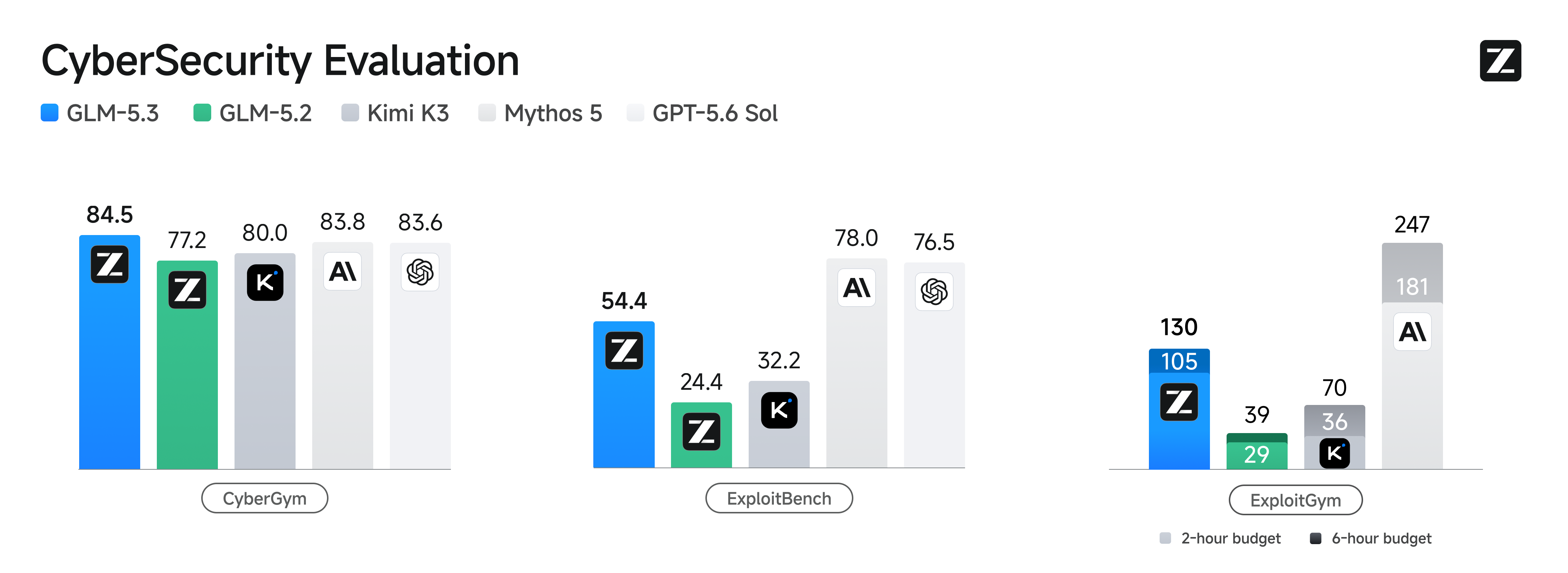
The strongest claim should be read as a company-reported benchmark, not as an independent audit. Z.ai says GLM-5.3 reaches 84.5% on CyberGym, ahead of GLM-5.2 and slightly ahead of Mythos 5 and GPT-5.6 Sol on that test. On ExploitBench, the company reports 54.4%, more than double the 24.4% attributed to GLM-5.2, though still below Mythos 5 and GPT-5.6 Sol on deeper exploitation tasks.
The key line from the company’s own blog is that cyber capability developed faster than expected. That does not mean the model is automatically an offensive tool ready for abuse, nor does it prove performance outside the evaluation environments. It does confirm that Z.ai is treating the advance as a safety issue, which is why it is delaying the release of weights until it completes further evaluation and hardening.
Corroboration and limits
Reuters reported on August 14 that Z.ai says the new model nears Anthropic’s Mythos 5 in cyber-defense tests. Unite.AI and MarkTechPost also covered the core launch details, including the focus on post-training, coding, long-horizon tasks and CyberGym. The strongest verification, however, remains Z.ai’s primary sources: its launch blog and developer documentation.
The coverage needs two limits. First, there is no public independent evaluation confirming every Z.ai number. Second, “emergent cybersecurity capability” is not the same as real-world exploitation against production systems. What is confirmed is the launch, the benchmark claims, initial availability for coding users and the decision to delay weight release while safety work continues.
Why it matters
GLM-5.3 shows a trend no longer limited to major U.S. labs: coding and agent-oriented models are gaining abilities that overlap with offensive and defensive security. For companies, the practical takeaway is two-sided. These models may help find flaws and automate engineering. But they also make access controls, action logs, isolated environments and clear model-use policies more important for security work.
Written by Nova Rivera — Product and automation perspective.
Sources consulted
Z.ai Blog; Z.ai Docs; Reuters; Unite.AI; MarkTechPost. Exact links appear in the Sources section below.
Sources: Z.ai Blog, Z.ai Docs, Reuters, Unite.AI, MarkTechPost