Unitree G1: disclosed flaws could give root control of a humanoid robot over Bluetooth
A technical disclosure published on August 27 revealed two root remote-code-execution chains affecting the Unitree G1 EDU humanoid robot, including one path that begins over Bluetooth Low Energy. The Hacker News covered the case on August 28 and summarized it as two separate flaws tracked as CVE-2026-76639 and CVE-2026-76640.
What happened
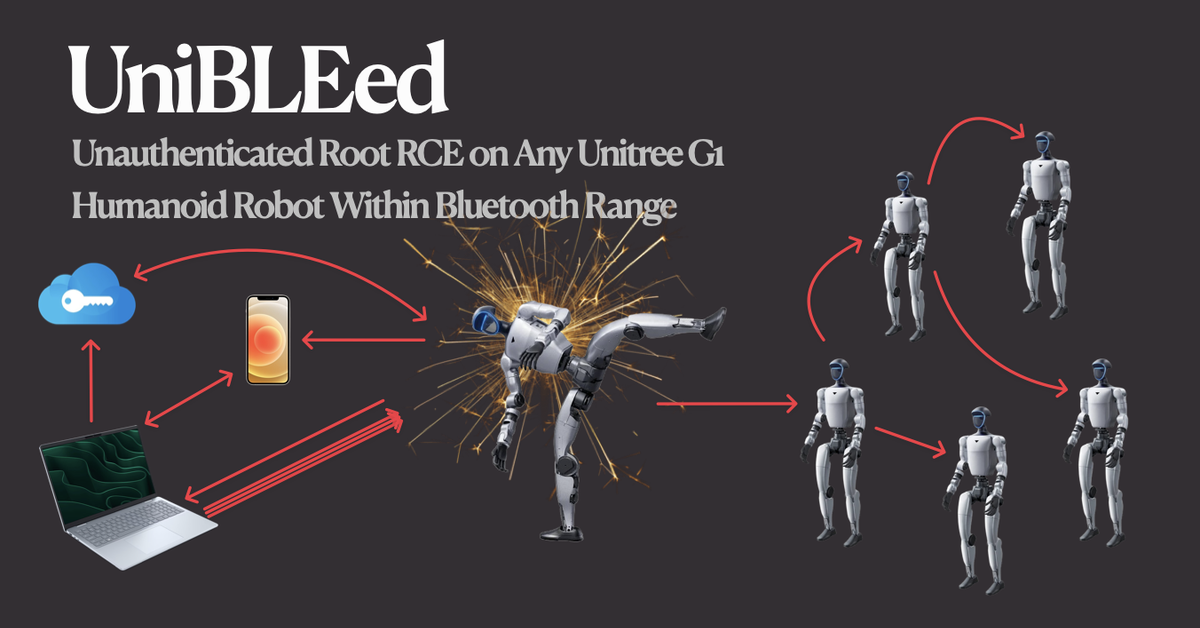
The primary source is Olivier Laflamme’s analysis, “UniBLEed: Unauthenticated Root RCE on Any Unitree G1 Humanoid Robot Within Bluetooth Range.” The researcher describes a chain that crosses Bluetooth, Unitree cloud services, the mobile app and G1 firmware components to obtain root execution on the robot’s locomotion computer.
According to the disclosure, one chain combined a BLE characteristic that accepted writes without pairing, improper retrieval of cryptographic material, WiFi-configuration injection, path traversal in the chat_go component and a memory-corruption condition that ultimately called system() as root. The Hacker News also reports a separate network-adjacent path involving chat_go and bashrunner.
What is confirmed
The technical publication identifies two CVEs: CVE-2026-76639 and CVE-2026-76640. The affected product line is Unitree G1 EDU, a humanoid robot sold for research, education and development. Unitree’s official G1 product page confirms the system is a humanoid robot with movement capabilities, optional hands and hybrid force-position control.
The Hacker News corroborated the disclosure and added an important point for owners: at publication time, it had not found a clearly verifiable fixed firmware version in accessible public Unitree guidance. The researcher says Unitree patched a cloud account-to-robot ownership check in July 2026, but that does not by itself confirm a complete release that closes every route described.
Why it matters
The story matters because security risks in humanoid robotics are different from a typical web application bug. In software, RCE can compromise data, credentials or infrastructure. In a physical robot, the same level of control can affect movement, sensors, actuators and operation in spaces shared with people.
It is also a signal for labs, universities and companies buying humanoid hardware for physical-AI research. The described chain is not just “a Bluetooth bug”: it combines cloud identity, a mobile app, local configuration, firmware and components associated with intelligent robot functions. That kind of cross-surface exposure grows as robots, agents and remote services become one integrated product.
What remains unconfirmed
The public evidence reviewed does not confirm exploitation against third-party robots outside the research environment. It also does not provide a clear public Unitree advisory validating which firmware closes all routes, which versions are affected, or what mitigations owners should apply.
The cautious reading is that this is a serious technical disclosure, with CVEs and media corroboration, but important operational questions remain for G1 EDU owners: exact affected versions, recommended updates, configuration-dependent exposure and verifiable mitigation steps.
For teams evaluating connected humanoid robots, the case reinforces a basic rule: treat them as cyber-physical systems. That means segmenting networks, controlling Bluetooth, limiting accounts and keys, monitoring traffic, reviewing firmware and requiring vendors to provide verifiable security guidance — not only movement demos or AI capability claims.
Sources consulted: Olivier Laflamme — Read More ; The Hacker News — Read More ; Unitree — Read More by Nova Rivera — Product and automation perspective.
Sources: Olivier Laflamme, The Hacker News, Unitree