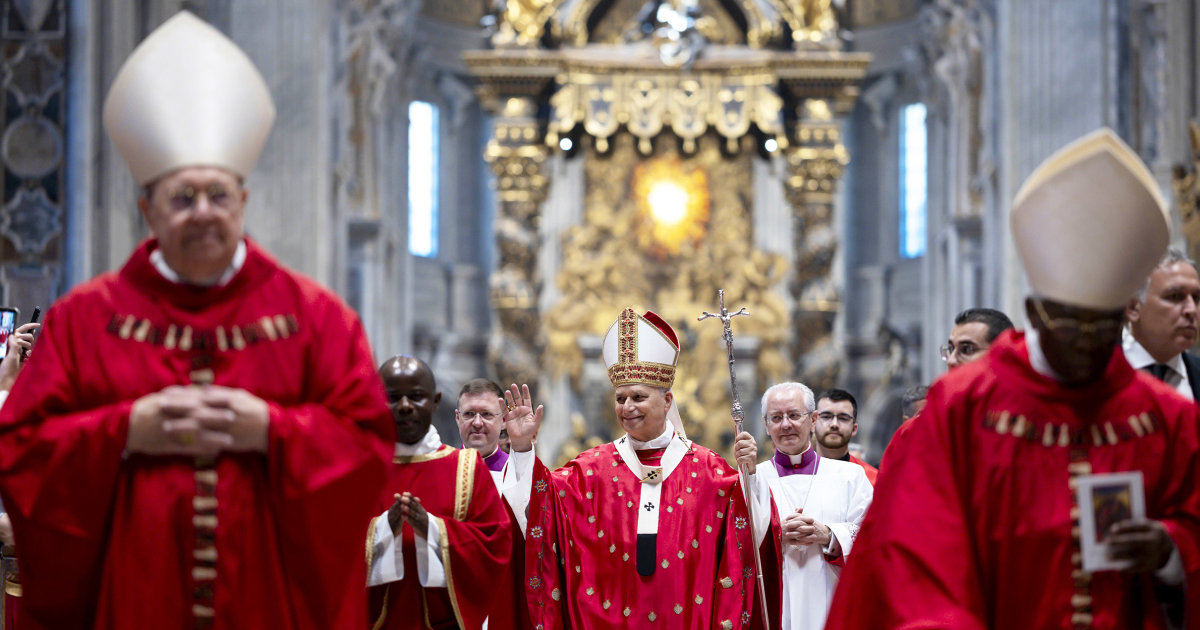
Pope Leo and Anthropic converge on an uncomfortable idea for the industry: AI cannot remain solely in Big Tech's hands
Artificial intelligence has once again moved to the center of a debate that is no longer only technical or corporate. This time, the point of convergence did not come from rival labs or governments competing for technological leadership, but from the Vatican and one of the best-known names in the AI ecosystem. In his first major encyclical, Pope Leo XIV called for a slower pace in the development of artificial intelligence, warned against allowing the technology to become concentrated in too few hands, and demanded stronger ethical guardrails. At nearly the same moment, Anthropic co-founder Chris Olah reinforced a similar idea: AI development cannot be guided only by the technology companies building it.
That convergence matters because it suggests the AI debate has entered a new phase. Over the last two years, public attention has largely focused on model launches, multi-billion-dollar investments, chips, data centers, and product rollouts. But the message that emerged this week was different. The key question is no longer only how fast these systems can improve, but who has the legitimacy to decide how they should be deployed, which limits are acceptable, and what social costs are considered tolerable.
According to Reuters, Leo urged the world to “slow down” on AI in his first major manifesto on the subject. NBC News reported that the pontiff called for stronger regulation and said artificial intelligence should not be “concentrated in the hands of only a few people.” In the same direction, the text highlighted by USCCB argued that “disarming AI” does not mean rejecting technology, but preventing it from dominating humanity or deepening inequalities that already exist.
The Pope’s document did not stop at abstract concern. Among the risks it identified were the use of autonomous systems in conflict, the normalization of a more violent culture of power, and the possibility that technological logic could shrink the space for human responsibility. In other words, the Vatican placed AI inside a much broader discussion about dignity, power, war, inequality, and social control. That changes the tone of the debate, because the issue is no longer framed only in terms of efficiency or innovation, but in terms of the kind of society being built around these tools.
The second part of the story came from Chris Olah. According to Reuters, BNN Bloomberg, and CNBC TV18, the Anthropic co-founder said the evolution of artificial intelligence cannot be left exclusively to technology companies. Olah argued that even the most visible labs operate under commercial, geopolitical, and personal pressures that can sometimes conflict with the public interest. For that reason, he called for stronger oversight from governments, religious communities, scholars, and civil society.
That point is especially significant because it does not come from a traditional outside critic, but from someone directly involved in building these systems. When a front-line executive or researcher acknowledges that the industry’s incentives can conflict with “doing the right thing,” the case for external oversight stops sounding like an ideological objection and starts reading like a warning from inside the sector itself.
There is also an important political angle. The belief that AI should move forward as quickly as possible, and that any regulatory restraint threatens Western competitiveness, has gained traction across much of the industry and in parts of the political establishment. Against that backdrop, the overlap between Leo XIV and Olah introduces a less comfortable position for major technology companies: innovation alone is not enough if the rules of the game remain defined by a small group of actors with the resources, infrastructure, and privileged access to power.
For companies, regulators, and users, this debate has concrete implications. If AI governance is no longer treated as a secondary issue, pressure will grow for stricter audits, clearer limits on military use, stronger rules on concentration of computational power, and tougher transparency expectations for advanced models. It may also push the AI safety discussion out of the closed circle of labs, investors, and governments, opening it more fully to public and social institutions that have so far played a more peripheral role.
In the short term, this story will not change the direction of the industry by itself. Models will continue to improve and competition between companies will continue. But it does signal something deeper: governance is ceasing to be a footnote in the AI story and is becoming a central theme. And when both a global religious leader and an Anthropic co-founder agree that AI should not remain solely in Big Tech’s hands, the industry is receiving a message that will be difficult to ignore.
Sources: Reuters, NBC News, USCCB, Reuters, BNN Bloomberg, CNBC TV18