NVIDIA RTX Spark Opens a New Battle for the Personal AI PC
From the traditional laptop to the personal agent
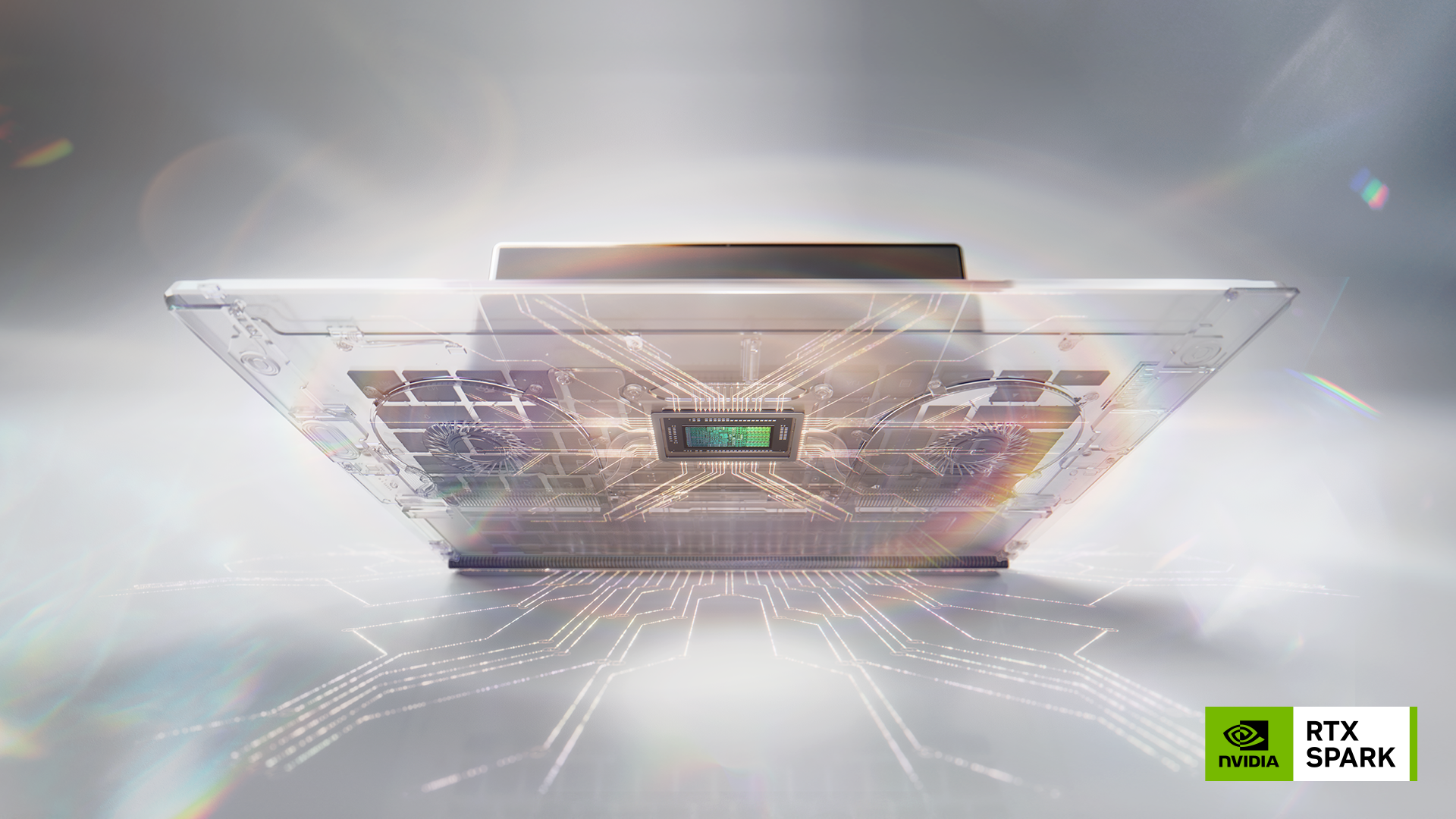
NVIDIA has just made an important move in the race to define what the next generation of personal computers will look like. In its joint announcement with Microsoft during GTC Taipei at Computex 2026, the company introduced RTX Spark, a new superchip for thin laptops and compact desktops with which it wants to turn Windows into a platform designed not just to open applications, but to run artificial intelligence agents directly on the user’s device.
The proposal is not limited to more graphics power or another attempt to sell “AI-ready” PCs. According to NVIDIA, RTX Spark was designed for a new class of personal computers capable of going from passive tools to assistants that carry out tasks, understand context, work with local files, and coordinate workflows across applications. In other words, the real ambition is not to launch another premium chip, but to push forward a new layer of agent-based personal computing.
What NVIDIA actually announced
The official announcement describes RTX Spark as a superchip with up to 1 petaflop of AI performance, up to 128 GB of unified memory, and an architecture that combines an NVIDIA Blackwell RTX GPU with 6,144 CUDA cores and fifth-generation Tensor Cores, together with a 20-core NVIDIA Grace CPU. The design was developed in collaboration with MediaTek, something that also makes clear that NVIDIA wants to enter the Windows PC arena with a strategy closer to the integration model Apple popularized with its Silicon family.
The company maintains that this technical package opens the door to workloads not normally associated with a thin laptop: rendering 3D scenes larger than 90 GB, editing 12K 4:2:2 video, generating AI video in 4K, and running language models with up to 120 billion parameters and contexts of up to one million tokens locally. Added to that is the promise of playing AAA titles at 1440p at more than 100 frames per second, a detail that reveals NVIDIA does not want to sell Spark merely as a productivity chip, but as a complete platform for creation, AI, and gaming.
The big bet: local agents and Windows as a native environment
The most important part of the announcement lies not only in raw power, but in the integration with Microsoft. NVIDIA and Windows are presenting RTX Spark as the foundation of a native experience for personal agents, with new operating system security primitives and a layer called NVIDIA OpenShell to control how those agents run, what permissions they have, when they query local models, and when they escalate to the cloud.
That point shifts the center of the conversation. Over the last two years, much of the “AI PC” narrative revolved around built-in assistants, dedicated keys, and summarization or search features. RTX Spark raises the stakes in another direction: a PC where the agent is not an add-on, but a structural part of the working environment. If that vision works, the advantage will lie not just in having a model within the system, but in controlling the combination of hardware, memory, security, local inference, and user experience.
The new battle for control of the PC
That is where Spark takes on strategic weight. Bloomberg described the move as a fight for “the soul of Windows PCs,” while PCMag frames it as NVIDIA’s biggest foray into consumer laptops to date. Both interpretations point to the same thing: NVIDIA no longer wants to limit itself to selling GPUs for data centers, gaming, or workstations, but to occupy a central place in the architecture of the device on which agents, models, and personal AI workflows will run.
That puts pressure on several fronts at once. Microsoft gains a partner with enough muscle to push a new Windows narrative. Apple faces a rival that adopts part of the logic of unified memory and integrated design, but takes it into the realm of local agents. Intel, AMD, and Qualcomm are forced to respond not only with performance, but with a convincing story about privacy, autonomy, and software capable of taking advantage of this new type of hardware.
What still needs to be proven
The promise, however, still has to survive market reality. It remains to be seen what the final price of the first devices will be, what their actual battery life will be under agentic workloads, how mature the software will be, and how many developers will be willing to build experiences truly designed for this environment. It will also be necessary to determine whether ordinary users want agents running persistently on their PCs or whether, beyond the initial enthusiasm, many of those tasks will continue to be handled in the cloud.
Even with those doubts, the announcement is already reshaping the conversation. RTX Spark is not presented as an incremental improvement, but as a bet on redefining the personal computer around local agents, privacy, and enough power to run serious AI without always depending on remote servers. If NVIDIA manages to translate that vision into competitive products this fall, the discussion about the future of the PC will cease to be a battle of specifications and become a fight over who controls the assistant living inside the device.
Sources: NVIDIA Newsroom, NVIDIA Blog, PCMag, Bloomberg