NVIDIA brings BioNeMo into Claude Science for biomedical research agents
NVIDIA brings BioNeMo into Claude Science for biomedical research agents
NVIDIA published an official video this week about BioNeMo Agent Toolkit, software designed to turn computational biology models, libraries and workflows into tools that artificial intelligence agents can call. The newest signal is not only the toolkit, announced at BIO 2026, but its integration with Claude Science, Anthropic’s new beta workbench for scientists.
What happened
Anthropic introduced Claude Science on June 30 as a research environment for scientific work. The company says the product is available in beta for Claude Pro, Max, Team and Enterprise users, and combines agents, connectors, skills and access to local, remote or high-performance computing. The pitch is that a researcher can ask for literature analysis, genomics work, protein tasks, chemistry workflows or reproducible figures in natural language, while the system produces auditable artifacts with code and conversation history.
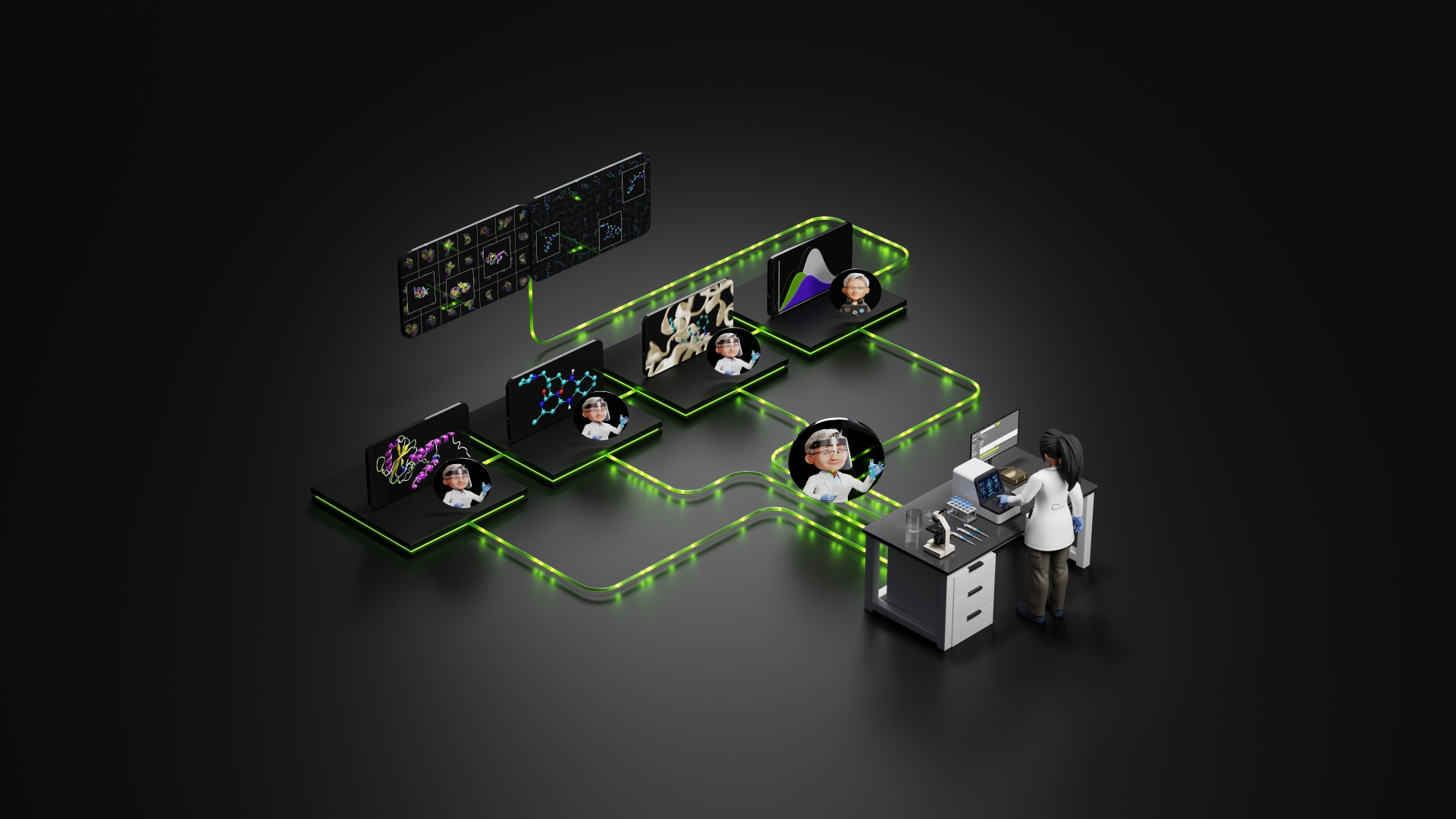
NVIDIA said in its blog that Claude Science integrates BioNeMo Agent Toolkit as a source of accelerated life sciences capabilities. The toolkit packages NVIDIA models, microservices and workflows as skills callable by agents. Examples cited by the sources include Evo 2, Boltz-2, OpenFold3, NIM microservices and tasks such as structure prediction, protein design, molecular docking, genomic analysis, biomarker discovery and generative chemistry.
How BioNeMo fits
The central idea is that a general agent may understand what kind of scientific problem it is facing, but not necessarily how to prepare valid inputs, choose the right model, interpret outputs or handle failures from specialized tools. BioNeMo tries to cover that gap with skills and Model Context Protocol-compatible wrappers, allowing an agent to discover capabilities, call services and return results that humans can review.
NVIDIA says more than 50 companies and organizations are already using the toolkit to advance scientific discovery, and that 18 of the top 20 global pharmaceutical companies use BioNeMo technologies. The company also presents the toolkit as an open and trusted layer for life sciences workflows built on NIM, Parabricks, NeMo, Nemotron and other pieces of its accelerated computing stack.
What is confirmed and what remains unproven
The verified facts are specific: Anthropic launched Claude Science in beta on June 30; NVIDIA published a BioNeMo integration with that environment; and NVIDIA’s July 2 official video summarizes the toolkit as infrastructure for scientific agents. Independent coverage from AI News / TechForge also describes the integration as a way to bring NVIDIA compute resources and models into the Claude Science workflow.
What is not established is that these agents broadly accelerate drug development, reduce research costs or replace experimental validation. The sources frame the system as an assistance and orchestration environment: it can prepare analyses, call models, manage compute and leave auditable traces, but outputs still require scientific review, quality control, data validation and experiments.
Editorial read
The move shows where part of the agent race is going: away from generic chat and toward specialized tools connected to domains where errors are expensive. In life sciences, the value depends not only on the conversational model, but on which instruments it can use, how it records its actions and whether a human team can reproduce or audit each step.
For pharmaceutical companies, labs and research teams, Claude Science and BioNeMo point to a more serious pattern than a chatbot demo: agents operating inside controlled environments, with access to compute, scientific models and domain-specific tools. The promise is faster cycles of hypothesis and analysis; the limit remains the same as in real science: without reproducible evidence and experimental validation, an AI output is not a discovery.
Sources consulted
NVIDIA video: Read More Blog: Read More Read More Science product page: Read More Newsroom: Read More Technical Blog: Read More News / TechForge: Read More by Nova Rivera — Product and automation perspective.
Sources: NVIDIA YouTube, NVIDIA Blog, Anthropic, NVIDIA Newsroom, NVIDIA Technical Blog, AI News / TechForge,