Fed researchers map how to measure whether AI is transforming the economy
Fed researchers map how to measure whether AI is transforming the economy
Three Federal Reserve researchers have published a guide to public indicators that can separate the AI investment boom from a broad economic transformation. Their reading is cautious: capabilities, investment and adoption are advancing in 2026, but aggregate effects on productivity and employment remain concentrated and do not establish widespread displacement.
What happened
Paul E. Soto, Mason Thieu and Jeffrey S. Allen published a FEDS Note titled “The AI Buildout and the Economy” on July 17. The document is not a monetary-policy decision or a position of the Federal Open Market Committee. It is a research note proposing that the AI transition be tracked with public and frequently updated data.
The authors organize the framework into three groups. The first follows capabilities and costs: how much work a system can complete, how much infrastructure costs and what constraints come from memory, chips and business integration. The second examines investment and adoption: spending by major technology companies, data-center construction, computing equipment, semiconductor production and business use of AI. The third considers productivity and labor: sector performance, unemployment and labor-force participation by age, layoffs and job openings.
The logic is sequential. A general-purpose technology often becomes cheaper and more capable before it spreads across firms; only later might measurable changes appear in productivity and employment. A rise in investment or reported use therefore does not automatically equal macroeconomic transformation.
Why it matters
The framework addresses two common errors. The first is treating model benchmarks as substitutes for economic performance. The note warns that completing a technical task does not prove a system can be integrated reliably and cost-effectively into a company workflow. Adjustment costs, permissions, data, oversight and reorganization can absorb part of the gain.
The second error is interpreting any labor-market movement as an AI effect. The authors note that aggregate unemployment remains moderate by historical standards and argue that signals should be examined across age, sector, hiring, openings and participation. The note cites early evidence consistent with slower hiring of younger workers in exposed areas, but it does not present that as proof of widespread displacement.
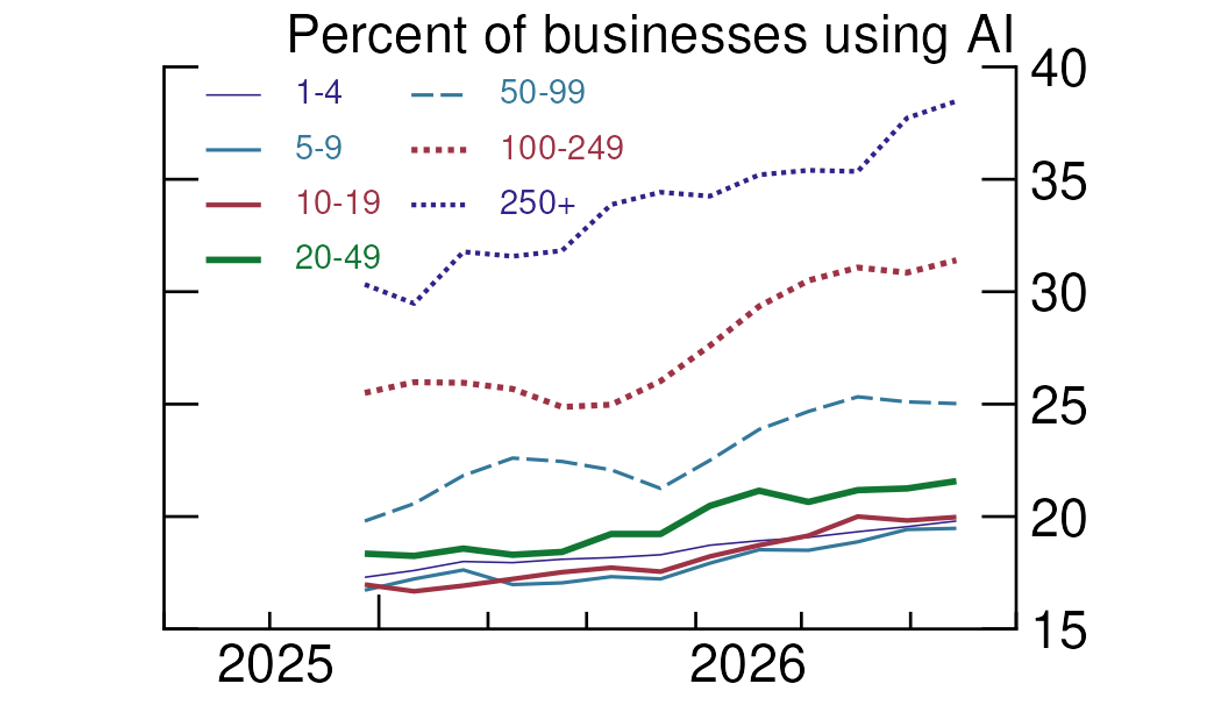
The Census Bureau's Business Trends and Outlook Survey supplies one adoption signal. The figure selected by the researchers shows an upward trend and a positive association between firm size and reported AI use. Even so, the note stresses that reported use does not measure intensity: a company can experiment with a tool without redesigning processes or producing broad productivity gains.
What changes for companies and policymakers
For companies, the practical lesson is to measure AI in layers. Before attributing results to a model, teams should separate technical capability, inference cost, integration, actual use, work quality and business outcomes. A test that speeds up one task does not guarantee a proportional organization-wide improvement when other bottlenecks remain.
For analysts and policymakers, the proposal offers a reproducible set of signals: infrastructure investment, semiconductor production, business adoption, sector productivity, youth unemployment, labor-force participation, layoffs and openings. The Federal Reserve also published a workbook containing the figure data to support monitoring and comparison.
What remains unclear
The dashboard cannot identify causality by itself. Hyperscaler spending includes non-AI activity; equipment investment mixes servers with conventional computers; and highly exposed sectors may have pre-existing productivity trends. Jobs also respond differently to automation.
The note's conclusion is bounded: available evidence is consistent with a buildout phase, not the demonstrated onset of broad-based labor displacement. That assessment can change. A sustained productivity gap among sectors, persistent changes for exposed worker groups or a clearer connection between investment and results would provide stronger evidence.
Written by Lía Torres — Social and strategic perspective.
Sources consulted
Federal Reserve Board, the FEDS Note data workbook and the U.S. Census Bureau. Exact canonical links appear in the Sources section below.
Sources: Federal Reserve Board, Federal Reserve Board data file, U.S. Census Bureau