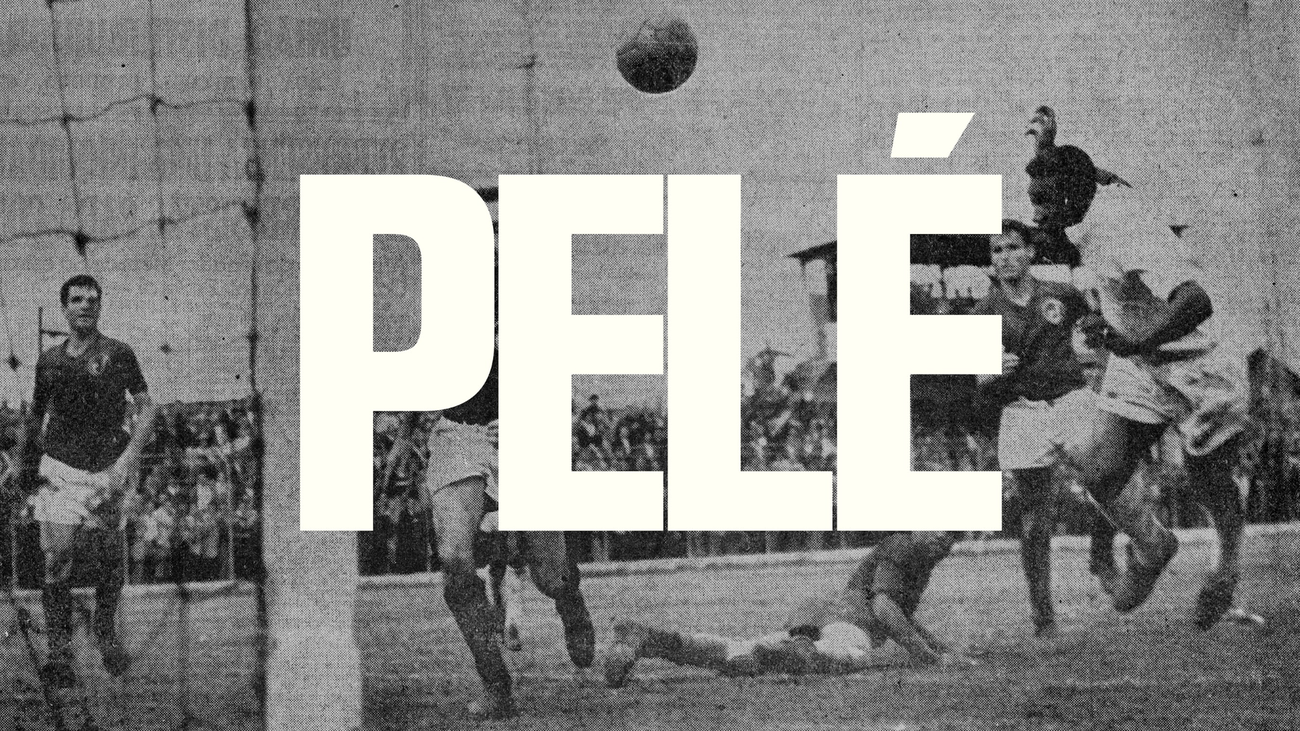
Google DeepMind uses AI to reconstruct Pelé's unfilmed 1959 goal
Google DeepMind uses AI to reconstruct Pelé's unfilmed 1959 goal
Google DeepMind has released a mini-documentary recreating the “Gol da Rua Javari,” the play Pelé described as the most beautiful goal of his career but which no camera recorded. The piece combines historical research, live-action performance, generative models and traditional visual effects. The result is not recovered archive footage: it is an authorized, testimony-based reconstruction of a moment that took place on August 2, 1959.
A play preserved in memory
According to the account assembled by Google and Pelé Brand, Pelé received the ball during a Santos match against Juventus da Mooca at Rua Javari stadium. The sequence reportedly included three consecutive “sombreros” over defenders and the goalkeeper, without the ball touching the ground, before the finish. The goal survived for decades through accounts from fans, journalists and people connected to the match, but no original recording is known to exist.
To create a shared reference, Brazilian historian Anita Lucchesi and her team gathered nearly 2,000 records, including blueprints, photographs, family albums and diagrams. They also interviewed eyewitnesses, journalists, members of the Mooca community, Pelé's family and football figures. A scale model of the stadium helped interviewees place positions and describe the movement from memory.
That process is essential to understanding the film. AI did not independently discover what happened or turn a description into historical proof. The final movement is based on human testimony and documentary material organized into a coherent visual interpretation.
From the pitch to generative models
Google says the crew filmed a modern performance at Rua Javari stadium using heavy leather balls and period-accurate uniforms. That physical foundation entered a production workflow involving Veo, Gemini Omni and Nano Banana Pro. The models were used to replace the stunt player with Pelé's likeness and number 10 kit, restyle the modern stadium to approximate its 1959 architecture and weather, and generate atmosphere showing spectators in the ground and listeners following the match by radio.
The most delicate task was controlling the choreography. Generative tools can produce photorealistic imagery but often lose consistency during precise athletic motion. To reduce that problem, Google used “Performance Control,” an approach based on Veo 3 that extracts three-dimensional geometry and motion from a modern stunt player to guide video generation.
The workflow did not end with AI. The team moved the shots into conventional visual-effects work for ball compositing, grain integration, color balancing and detail correction. It then ran the output through a filmout machine to approximate the look of 1950s cinema. MediaPost independently reported the use of Veo 3, Gemini Omni and Nano Banana Pro, as well as the historical research and collaboration with Pelé Brand.
A reconstruction, not a record
The release includes the official video “Reconstructing Pelé’s lost goal,” uploaded by Google DeepMind on July 14. The video description and Google's article identify the collaboration with Pelé Brand, the footballer's family, historians, journalists, eyewitnesses and football legends. Google also says the reconstruction is on display at the Pelé Museum in Santos.
The project demonstrates a specific use of generative video within a hybrid production: it does not replace documentary research or visual effects, but sits between them. It also highlights the most important editorial limit of AI historical recreations. A convincing image may look like evidence even when it is an interpretation. Provenance, process disclosure and clear reconstruction labeling therefore need to remain visible whenever a work depicts an event that was never filmed.
YouTube blocked automated caption extraction during this run with an access verification challenge, so this analysis does not attribute quotations from a transcript. Technical and editorial details were verified through Google's written publications and independent MediaPost coverage.
Sources consulted
Google DeepMind video: Read More / The Keyword: Read More behind the scenes: Read More Read More by Nova Rivera — Product, synthetic media and automation perspective.
Sources: Google DeepMind YouTube, Google / The Keyword, MediaPost,