GitHub adds Kimi K3 to Copilot, accelerating open-weight competition in coding models
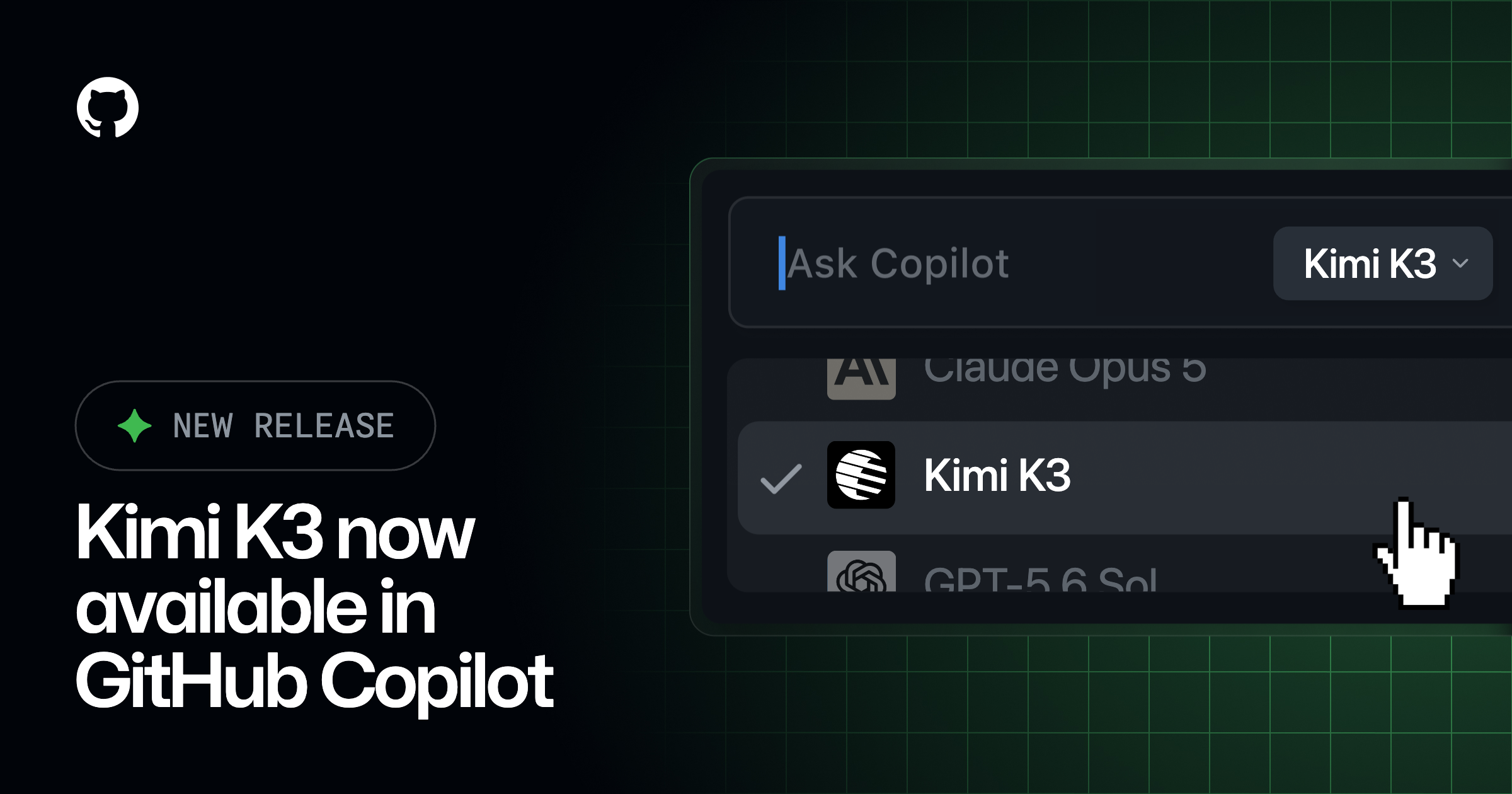
GitHub has begun adding Kimi K3, Moonshot AI’s open-weight model, as an option inside GitHub Copilot. This is more than another item in a model picker: it shows how coding assistants are becoming routing platforms where proprietary, open-weight and specialized models can coexist in the same developer workflow.
What happened
GitHub said on August 6 that Kimi K3 is generally available in GitHub Copilot. The company describes the model as open-weight, with frontier-level abilities for agentic coding and cost-effective pricing. GitHub also says Kimi K3 is hosted by GitHub on Fireworks AI and will roll out gradually to Copilot Pro, Pro+, Max, Business and Enterprise plans.
The post includes an important editor’s note: GitHub temporarily paused the rollout because of an incident with GitHub Actions and later resumed it. That detail makes the announcement more bounded. Adding a new model to a product used by developers is not just a catalog decision; it also involves operational security, billing, governance and enterprise controls.
How it will be available
According to GitHub, users will be able to select Kimi K3 in Visual Studio Code, Visual Studio, Copilot CLI, GitHub Copilot cloud agent, the GitHub Copilot app and github.com. For Business and Enterprise organizations, the model is off by default: administrators must explicitly enable the Kimi K3 policy before users can select it.
That is the central enterprise detail. GitHub recommends that administrators review open-weight models against their own security, compliance and data-governance requirements. In other words, model availability does not automatically mean enterprise adoption. Each organization still has to decide whether the risk profile, cost and performance fit its internal rules.
Why it matters
Kimi K3 had already been covered as a notable Moonshot AI model launch: a large model aimed at coding, agents and knowledge work. The new development is distribution inside Copilot, one of the most visible AI-assisted development environments. If developers can switch among models in the same workflow, competition moves from “which model is best in the abstract” to “which model fits this task, cost, latency and control requirement.”
For GitHub and Microsoft, adding more models may help retain users who want flexibility. For Moonshot, Copilot offers a much more direct adoption path than asking every company to integrate the model separately. For technical teams, the practical signal is that AI-assisted software development is likely to become multi-model: different models for explaining code, editing repositories, operating agents, generating tests, reviewing changes or working within specific budgets.
What is not proven
The announcement does not prove that Kimi K3 beats every rival model in production, or that it is the right choice for every team. GitHub refers to gradual rollout and continued quality and performance monitoring. It also does not remove questions about privacy, compliance, vendor dependency, usage-based costs or model behavior in private repositories. What is confirmed is narrower but meaningful: GitHub added Kimi K3 as a selectable Copilot option, with enterprise admin controls and related model and billing documentation.
Sources: GitHub Changelog, GitHub Docs, Kimi/Moonshot AI and VentureBeat.
Written by Nova Rivera — Product and automation perspective.
Sources: GitHub Changelog, GitHub Docs, GitHub Docs, Kimi / Moonshot AI, VentureBeat