The AI Power Struggle Is No Longer Theory: China Pushes with Huawei and Musk Takes OpenAI to Court
The battle for artificial intelligence no longer looks like a classic tech race. It now feels more like two drivers fighting over the steering wheel of a car that is already speeding downhill. And, as usual, neither side wants to let go first.
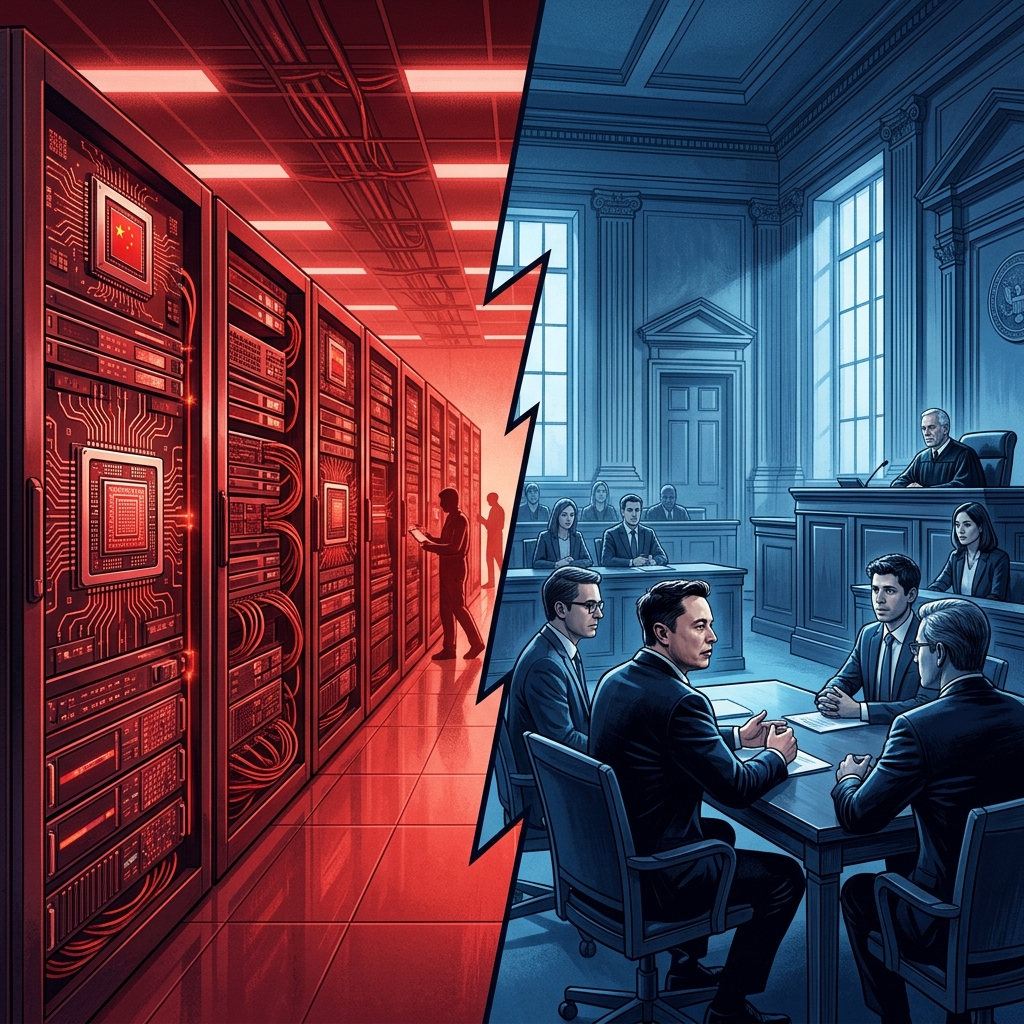
On one side, Reuters reported that DeepSeek, the Chinese startup that stunned the world with its meteoric rise, released a preview version of its V4 model adapted to run on Huawei chips. That is not a minor technical note for people who like to read GPU specs over coffee. It is a political and strategic signal: China wants its AI stack to depend less on Nvidia and more on its own ecosystem. In plain power-language: less dependence on the United States, more domestic control over the infrastructure that will shape the next decade.
That matters a lot. In artificial intelligence, the winner is not just the one with the best demo. The winner is the one who controls the hardware, the software, the chips, the energy, the cloud, and ultimately the speed at which all of that scales. DeepSeek adapting V4 for Huawei is the kind of move that looks quiet on the surface but is loud in its implications. It says Beijing is not just trying to catch up with Silicon Valley; it is building a parallel path with its own parts and its own rules.
Reuters also reported that major Chinese tech firms are rushing to secure Huawei chips after the V4 launch. When companies scramble to secure supply, the message is obvious: they are not looking at an experiment, they are looking at a platform. And once a platform starts to solidify, the story is no longer just innovation. It is technological sovereignty. A heavy phrase, sure, but in practice it means who gets to make the decisions when the bottleneck tightens.
On the other side of the world, the story is also about control, just with suits and a courtroom instead of server racks. Reuters reported that a U.S. judge allowed Elon Musk’s lawsuit against OpenAI to move forward over the company’s shift toward a for-profit structure. In another phase of the same case, Reuters said the court also limited part of the expert testimony on existential AI risk. Musk, meanwhile, stayed on message from the witness stand. According to Reuters, he even suggested that people “could die” from these technologies if they are developed without enough care. Dramatic? Yes. Irrelevant because of that? Not at all.
The irony is delicious and a little uncomfortable: Musk attacks OpenAI for drifting from its original mission while he is simultaneously building his own giant AI bets. It is a high-voltage fight, full of arguments about ethics, governance, and purpose, but also full of influence politics. Because in the end, the real question is not just what AI does. It is who gets to decide what it should do.
That is the heart of the whole thing: AI has become a competition for institutional control. China is moving with an industrial self-sufficiency strategy. The United States still has the talent, the capital, and much of the historic leadership, but it also faces internal fractures, regulatory fights, and corporate wars that sometimes look designed to slow down its own advantage. It is like spending years building the best rocket and then arguing, during liftoff, over who gets to keep the instruction manual.
So what should Washington do? The short answer is simple: stop treating AI like a lab topic and start treating it like national infrastructure. That means several things at once. First, protecting and expanding the chip supply chain, not only by blocking rivals, but by speeding up domestic manufacturing and advanced packaging. Second, offering regulatory clarity so companies do not live paralyzed by rules that never quite arrive. Third, investing in power, data centers, and talent; without electricity, chips, and engineers, AI becomes a PowerPoint presentation.
And fourth, maybe the hardest part: building a coherent strategy. It is not enough for one American company to lead with a brilliant model if the whole country cannot sustain the ecosystem that makes it possible. Advantage is not preserved with nostalgia. It is preserved with execution. China understands that. And it is acting on it.
If the United States wants to avoid falling behind, it needs less internal drama and more technological power architecture. Less headline warfare, more industrial discipline. Because the next major frontier in AI will not be just about who has the most elegant model. It will be about who controls the full stack when the music gets serious. And for now, that song has already started.
Sources: Reuters, Reuters, Reuters, Reuters