Couchbase launches AI Data Plane to give AI agents persistent memory
Couchbase launches AI Data Plane to give AI agents persistent memory
Couchbase introduced AI Data Plane, a data infrastructure layer designed to give artificial intelligence agents persistent, contextual and governed access to operational information. The announcement points to an increasingly visible enterprise problem: agents do not only need to generate answers; they also need to remember, retrieve and act on current data without weakening security controls.
What happened
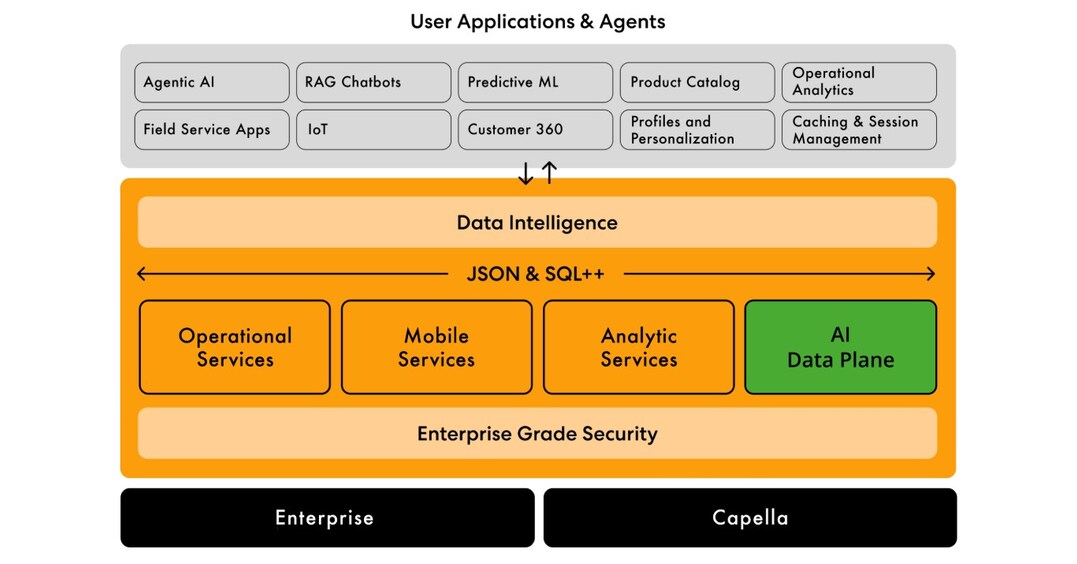
Couchbase announced on June 30 the general availability of AI Data Plane, which it describes as unified infrastructure for AI applications and agents. The release distributed through PR Newswire, aligned with Couchbase’s canonical press page, presents the platform as an extension of its operational database and Capella, its managed cloud service.
The offering combines operational, mobile and analytics services with vector search, JSON data, SQL++ and synchronization toward edge environments. In practical terms, Couchbase wants an agent to maintain persistent memory, retrieve relevant context, work with recent enterprise data and operate across cloud, distributed applications and edge computing scenarios.
VentureBeat summarized the angle as persistent agent memory at the edge, which captures the broader shift: the agent discussion is moving from conversational demos toward infrastructure that enables continuity, state and reliable execution.
Why it matters
Many agent pilots break down when they leave controlled environments. A chatbot can answer a question using static documents, but an enterprise agent needs something harder: to know which information it is authorized to use, retrieve the right context, operate on changing data, preserve task or session memory and work close to the user or device when latency matters.
That is where database providers, cloud platforms and automation tools are now competing. Agent memory is not only a model feature. It depends on vector databases, transactional storage, permissions, synchronization, observability and security policies. Couchbase is trying to position AI Data Plane as that operational layer, not as another generative model.
What changes for users, companies and the AI ecosystem
For companies, the announcement reinforces a practical point: adopting AI agents will not only mean choosing among OpenAI, Anthropic, Google or open models. It will also mean deciding where context lives, how it is updated, what data an agent can touch and how those interactions are audited.
For developers, a platform such as AI Data Plane promises to narrow the gap between RAG prototypes, mobile applications, operational analytics and agents that execute tasks. If it works as described, it could support more continuous experiences: field-service assistants with service history, intelligent catalogs with updated inventory, customer support with persistent profiles or internal workflows that combine transactional and analytical data.
Product and automation context
Nova Rivera’s reading is that this story fits the more mature stage of AI agents: fewer claims about systems that “think on their own” and more infrastructure for systems that do useful work within boundaries. Persistent memory can be powerful, but it also creates responsibility. An agent that remembers incorrectly, accesses excessive data or synchronizes sensitive context without controls can create new operational risks.
So the editorial point is not that Couchbase has solved agent memory. What is confirmed is narrower: the company launched a commercial layer to connect operational data, search, analytics, mobility and edge capabilities for AI applications. Its importance will depend on real adoption, integration with existing stacks and data-governance quality inside each organization.
What remains unclear
The announcement does not provide independent performance, cost or productivity measurements against alternative architectures. It also does not prove that one data platform is enough for every enterprise agent use case. Even so, it shows where the market is heading: advantage will not sit only in the model, but in the ability to connect it to reliable data, persistent memory and enterprise controls.
Sources consulted
Couchbase / PR Newswire: Read More canonical press page: Read More Read More News RSS: Read More by Nova Rivera — Product and automation perspective.
Sources: Couchbase / PR Newswire, Couchbase canonical press page, VentureBeat, Google News RSS discovery