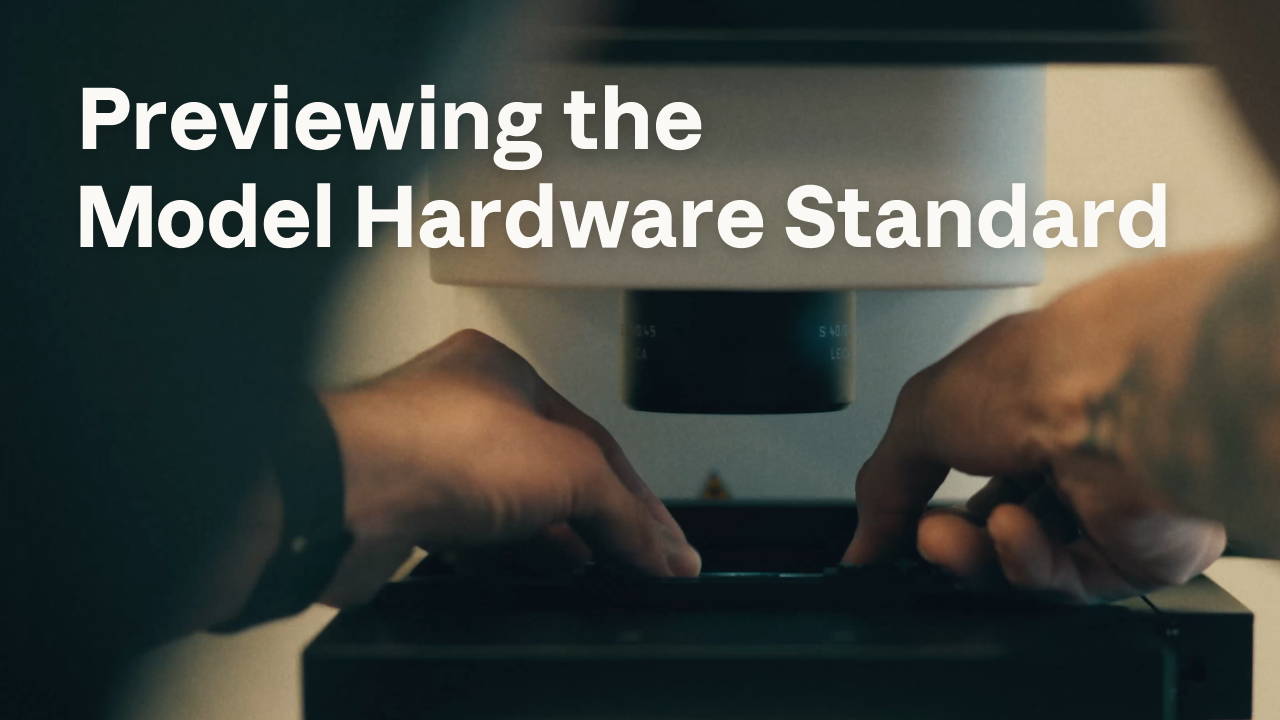
Anthropic opens a standard for AI agents to operate physical hardware
Anthropic opened a research preview of the Model Hardware Standard (MHS), a shared specification for artificial intelligence agents to discover, understand and operate programmable physical devices in labs, manufacturing and robotics. Published on August 27, the announcement moves AI agents into a more sensitive domain: not only answering text or calling APIs, but coordinating real instruments such as microscopes, liquid handlers, robotic arms and calibration equipment.
What happened
Anthropic says MHS is meant to reduce hardware integration work that can currently take weeks or months. The company describes the standard as a layer of drivers and metadata that translates device capabilities into simple commands — such as reading a temperature or setting a parameter — and lets an agent find equipment, understand its characteristics and control it through interfaces including the Model Context Protocol, command line tools and APIs.
The initial preview is aimed at a first group of scientific research labs and advanced manufacturers. Anthropic says development began with HHMI Janelia and that it now wants to work with partners across science, robotics, electronics and manufacturing before making the standard open source. In a separate post the same day, the company also announced broader support for scientists, including 10,000 Claude seats for researchers and expanded science credits, reinforcing the research and technical-operations focus of the story.
Why it matters
Most enterprise agents today operate in software: reading documents, querying databases, writing code or calling web services. MHS points toward a more complex frontier: agents that can sequence physical steps, monitor results, adjust parameters in real time and chain instructions for long-running or fast tasks without reasoning through every step manually.
If it works, the approach could speed experiments and manufacturing workflows where the bottleneck is not only cognitive, but also the integration between instruments. But because it touches physical hardware, the standard also raises the safety bar. A software error may produce a bad answer; an error involving a robot, lab instrument or industrial machine can affect equipment, samples, processes or people.
What is confirmed
What is confirmed is that Anthropic published MHS as a research preview, presents it as model-agnostic and compatible with standard protocols, and wants to test it with partners before a broader release. CNBC and Wired also covered the August 27 move as Anthropic’s push to bring AI agents into the physical world, while Anthropic remains the primary source for technical details.
What remains unclear
The announcement does not prove that MHS is already a de facto standard, nor that it can safely operate any physical device in real environments. It also does not confirm independent results, broad manufacturer adoption or full public risk evaluations. The cautious reading is that Anthropic is opening an experimental layer for connecting agents to hardware; its value will depend on testing, access controls, operational limits and auditing in each implementation.
For technical teams, the signal is clear: the next wave of agents is not limited to chatbots or IDEs. It is beginning to move toward labs, machines and physical processes, where governance will matter as much as automation.
Sources consulted: Anthropic — Read More ; Anthropic — Read More ; CNBC — Read More ; Wired — Read More by Nova Rivera — Product and automation perspective.